I’ve said this many times: the products we see on the market are rarely visionary leaps. Most of the time, they are mirrors. They reflect people’s habits, shortcuts, fears, and small daily behaviours. Design follows behaviour. Always has.
Think about it. You probably know at least one person who already uses ChatGPT for health-related questions. Not occasionally. Regularly. As a second opinion. As a place to test concerns before saying them out loud. Sometimes even as a therapist, a confidant, or a space where embarrassment does not exist.
When habits become consistent, companies stop observing and start building. At that point, users are no longer just customers. They are co-architects. Their behaviour quietly shapes the product roadmap.
That context matters when looking at what OpenAI announced on January 7, 2026: the launch of ChatGPT Health, a dedicated AI-powered experience focused on healthcare. OpenAI describes it as “a dedicated experience that securely brings your health information and ChatGPT’s intelligence together.”

The 💜 of EU tech
The latest rumblings from the EU tech scene, a story from our wise ol’ founder Boris, and some questionable AI art. It’s free, every week, in your inbox. Sign up now!
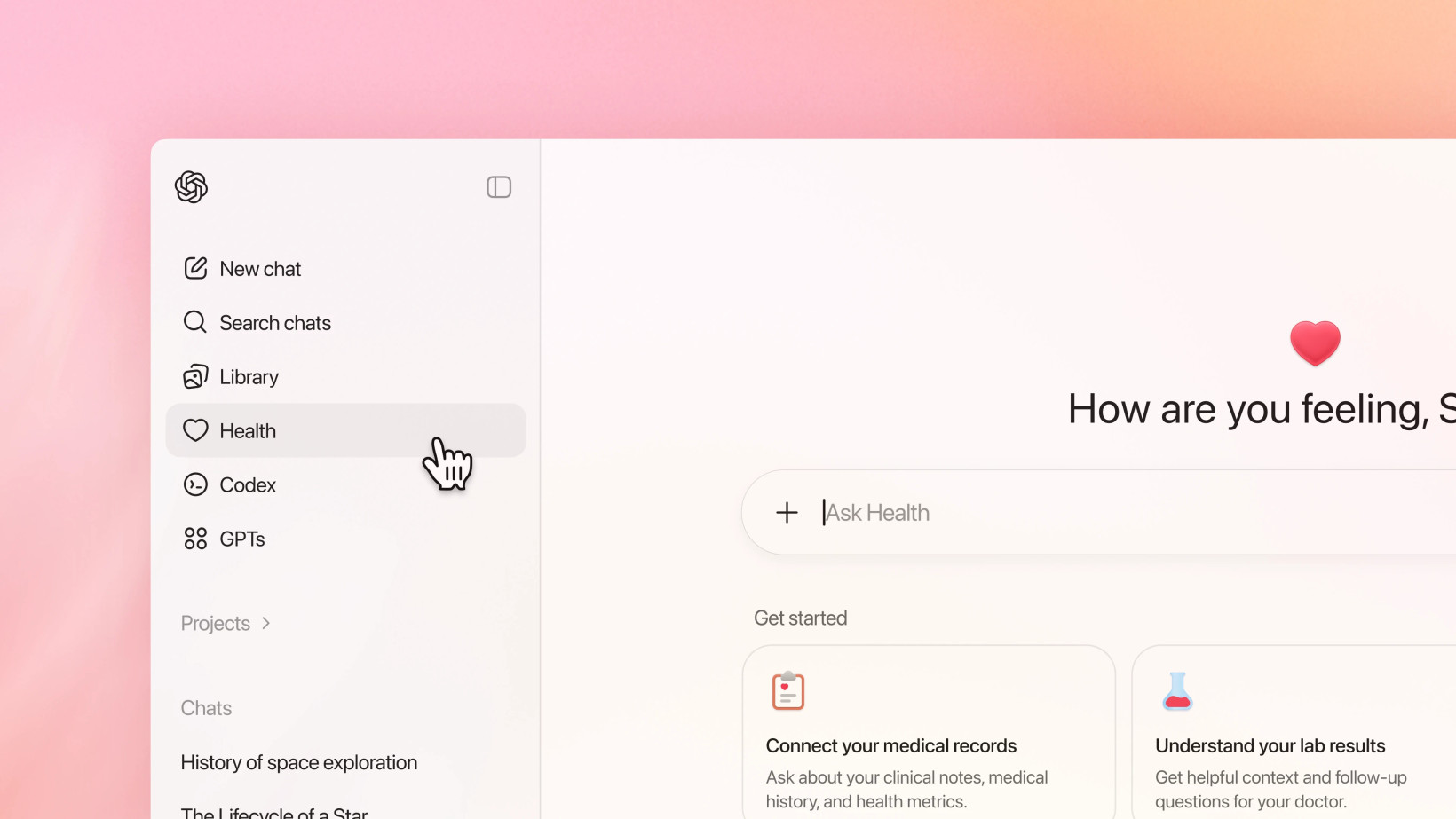
Image: OpenAI
Access is limited for now. The company is rolling it out through a waitlist, with gradual expansion planned over the coming weeks. Anyone with a ChatGPT account, Free or paid, can sign up for early access, except users in the European Union, the UK, and Switzerland, where regulatory alignment is still pending.
The stated goal is simple on paper: help people feel more informed, more prepared, and more confident when managing their health. But the numbers behind that decision say more than the press language ever could. According to OpenAI, over 230 million people worldwide already ask health or wellness questions on ChatGPT every week.
That figure raises uncomfortable questions.
Why do so many people turn to an AI for health questions? Is it speed? The promise of an immediate answer? The way our expectations have shifted toward instant clarity, even for complex or sensitive issues? Is it discomfort, the reluctance to speak openly with a doctor about certain topics? Or something deeper, a quiet erosion of trust in human systems, paired with a growing confidence in machines that do not judge, interrupt, or rush?
ChatGPT Health does not answer those questions. It simply formalises the behaviour.
According to OpenAI, the new Health space allows users to securely connect personal health data, including medical records, lab results, and information from fitness or wellness apps. Someone might upload recent blood test results and ask for a summary. Another might connect a step counter and ask how their activity compares to previous months.
The system can integrate data from platforms such as Apple Health, MyFitnessPal, Peloton, AllTrails, and even grocery data from Instacart. The promise is contextual responses, not generic advice. Lab results explained in plain language. Patterns highlighted over time. Suggestions for questions to ask during a medical appointment. Diet or exercise ideas grounded in what the data actually shows.
What ChatGPT Health is careful not to do matters just as much as what it can do.
OpenAI is explicit: this is not medical advice. It does not diagnose conditions. It does not prescribe treatments. It is designed to support care, not replace it. The framing is intentional. ChatGPT Health positions itself as an assistant, not an authority. A tool for understanding patterns and preparing conversations, not making decisions in isolation.
That distinction is crucial. And, frankly, it is one I hope users take seriously.
Behind the scenes, OpenAI says the system was developed with extensive medical oversight. Over the past two years, more than 260 physicians from roughly 60 countries reviewed responses and provided feedback, contributing over 600,000 individual evaluation points. The focus was not only accuracy, but tone, clarity, and when the system should clearly encourage users to seek professional care.
To support that process, OpenAI built an internal evaluation framework called HealthBench. It scores responses based on clinician-defined standards, including safety, medical correctness, and appropriateness of guidance. It is an attempt to bring structure to a domain where nuance matters and mistakes carry weight.
Privacy is another pillar OpenAI insists on emphasising. ChatGPT Health operates in a separate, isolated environment within the app. Health-related conversations, connected data sources, and uploaded files are kept entirely separate from regular chats. Health data does not flow into the general ChatGPT memory, and conversations in this space are encrypted.
OpenAI also states that health conversations are not used to train its core models. Whether that assurance will be enough for all users remains to be seen, but the architectural separation signals an awareness of how sensitive this territory is.
In the United States, the system goes a step further. Through a partnership with b.well Connected Health, ChatGPT Health can access real electronic health records from thousands of providers, with user permission. This allows it to summarise official lab reports or condense long medical histories into readable overviews. Outside the US, functionality is more limited, largely due to regulatory differences.
There are potential downstream effects for healthcare providers as well. If patients arrive at appointments already familiar with their data, already aware of trends, already prepared with focused questions, consultations could become more efficient. Less time decoding numbers. More time discussing decisions.
And inevitably, the question surfaces: should doctors be worried?
No. Not seriously.
AI is not a medical professional. It does not examine patients. It does not carry legal responsibility. It cannot replace clinical judgement, experience, or accountability. ChatGPT Health does not change that. It is not a shortcut to self-diagnosis, and it should not be treated as one.
What it does change is the starting point of the conversation.
Used responsibly, ChatGPT Health can help people engage with their own health information instead of avoiding it. Misused, it could reinforce false certainty or delay necessary care. The responsibility, as always, is shared between the tool and the person using it.
Users should stay aware of privacy implications, seek professional advice when it matters, and treat AI guidance as one input among many, not a final answer.
One thing is clear, though. 2026 did not arrive quietly.